


1.0 Introduction
Greater Eastern Africa is experiencing simultaneous economic expansion and systemic financial illicit fragmentation (AfDB, 2025). Accelerated infrastructure development and expanding digital payment ecosystems have strengthened regional growth trajectories across Kenya, Ethiopia, Uganda, and Tanzania (IMF, 2025). Intensified cross-border trade integration has further deepened economic interdependence within IGAD and East African Community corridors (UNCTAD, 2023), yet these gains coexist with structurally embedded illicit financial architectures operating through both formal banking systems and informal value transfer networks (UNODC, 2021). Illicit financial networks, including trade misinvoicing, corruption-enabled capital extraction, and unregulated transnational transfers, increasingly shape economic outcomes in ways that remain partially outside regulatory visibility (GFI, 2024).
These dynamics are reinforced by uneven enforcement capacity, fragmented jurisdictional coordination, and differentiated financial intelligence capabilities across states, producing persistent asymmetries in detection, enforcement, and recovery (ESAAMLG, 2024). The result is systemic embedding of illicit financial circulation within regional economic circuits, weakening fiscal sovereignty, regulatory coherence, and institutional resilience (Monkam, 2024). These structural conditions intensify governance stress through the sequential breakdown of anticipatory capacity, enabling mobility-linked financial flows to bypass formal controls and reinforcing cross-border exposure to unregulated capital movement (IOM, 2024). This commentary examines the structural relationship between illicit financial architectures and emerging security risks in Greater Eastern Africa.
2.0 Key Issues
2.1 Structural Trade Mispricing as a Fiscal Extraction System
Trade valuation regimes across Greater Eastern Africa function as structurally uneven fiscal interfaces in which pricing signals are systematically decoupled from underlying commodity value formation, enabling predictable extraction of public revenue through cross-border arbitrage mechanisms embedded in routine customs processing (UNCTAD, 2023). In extractive corridors linking the Democratic Republic of Congo, Uganda, and external re-export destinations, valuation distortion operates not as a deviation but as a normalised administrative practice sustained by asymmetric enforcement capacity (OECD, 2024). This configuration transforms customs systems into passive fiscal leakage conduits where revenue is displaced prior to national accumulation, weakening institutional resilience within revenue authorities (WCO, 2024). Mobility-linked cross-border commodity circulation further reinforces exposure to valuation arbitrage within transit economies, embedding financial distortion within trade mobility corridors (IOM, 2024). Global Financial Integrity identifies trade misinvoicing as a persistent structural mechanism of illicit capital movement embedded in global trade systems (Kar, 2024).
2.2 Corruption as a Recursive Fiscal Governance Distortion System

Corruption in Greater Eastern Africa operates as a recursive governance distortion system in which administrative authority is systematically converted into private capital accumulation through procurement regimes, licensing structures, and public expenditure architectures (AUABC, 2025). Rather than functioning as an episodic deviation, corruption is structurally embedded within fiscal decision-making systems, producing continuous outward financial leakage through formal state mechanisms (UNODC, 2024). This configuration generates self-reinforcing institutional erosion, where fiscal governance structures simultaneously allocate and extract public resources, undermining institutional resilience from within (AfDB, 2025). Mobility-linked political economy structures, including cross-border contracting networks and transnational procurement flows, further amplify exposure to illicit capital circulation (IGAD, 2025). Transparency International (2024) identifies persistent concentration of corruption within procurement and resource allocation systems across Eastern Africa. Monkam (2024) demonstrates that such flows reduce domestic investment capacity and weaken long-term developmental fiscal stability.
2.3 Informal Financial Systems as Dual Liquidity Sovereignty Architecture
Informal financial systems in Greater Eastern Africa constitute a dual liquidity sovereignty architecture operating in parallel with formal banking structures, enabling essential financial inclusion while simultaneously generating structurally opaque financial corridors (World Bank, 2025). These systems, comprising hawala-style transfers, rotating savings associations, and cross-border cash settlement networks, are anchored in relational trust rather than institutional traceability, limiting regulatory visibility (FATF, 2024). The United Nations Office on Drugs and Crime (2021) identifies informal value transfer systems as decentralised financial infrastructures that fall outside standard AML/CTF detection frameworks. Kar (2024) demonstrates that these systems are frequently leveraged for concealment and cross-border movement of illicit proceeds due to minimal documentation requirements. UNCTAD (2023) situates their persistence within structural financial exclusion across rural and peri-urban economies, reinforcing dependence on non-formal liquidity channels. Alliance for Financial Inclusion (2024) further links informal liquidity dependence to uneven banking penetration across borderland economies.
2.4 Fragmented Financial Intelligence and Collapsed Anticipatory Detection Capacity
Financial intelligence systems across Greater Eastern Africa remain institutionally fragmented, producing a structurally reactive rather than anticipatory detection environment in which illicit financial activity is identified post-occurrence rather than pre-escalation (ESAAMLG, 2024). Suspicious transaction reporting frameworks operate primarily as compliance verification instruments rather than predictive analytical systems capable of generating early warning signals (World Bank, 2025). Europol (2016) demonstrates that integrated financial intelligence architectures can detect pre-operational behavioural patterns when datasets are structurally harmonised across jurisdictions. TRACFIN (2016) further identifies cross-system financial convergence analysis as critical to anticipatory threat detection within transnational financial systems. In contrast, IGAD and East African Community financial intelligence systems remain weakly interoperable, limiting cross-border analytical convergence and disrupting regional risk sequencing capacity (IGAD, 2025). Mobility-linked financial flows across trade and migration corridors further complicate detection symmetry, increasing latency in the identification of transboundary anomalies (IOM, 2024).
3.0 Conclusion
The structural configuration of illicit financial networks in Greater Eastern Africa reveals a convergent system in which trade mispricing, corruption architectures, informal liquidity sovereignty, and fragmented intelligence systems collectively weaken fiscal and security governance capacity. These interlocking dynamics reinforce systemic opacity across cross-border financial circuits while eroding institutional resilience within regional regulatory frameworks. The cumulative effect is a persistent breakdown in anticipatory governance, limiting the ability of institutions to sequence and interrupt emerging financial risks before escalation. This diagnostic convergence underscores a regional environment increasingly defined by structural latency in financial detection systems and asymmetry in enforcement coordination across IGAD and East African Community jurisdictions. The analysis consolidates the four diagnostic strands into a unified risk environment defined by delayed visibility, fragmented enforcement, and constrained institutional responsiveness across evolving financial security architectures in Greater Eastern Africa.
4.0 Policy Recommendations
4.1 IGAD to Operationalise the Regional Trade Valuation Audit System
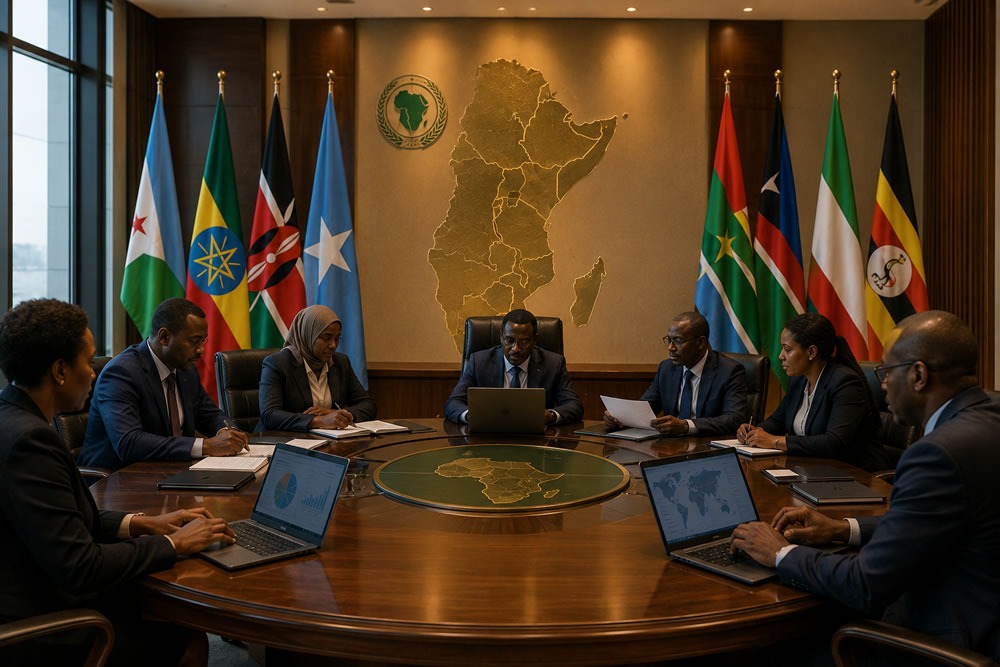
The Intergovernmental Authority on Development (IGAD) Secretariat, in coordination with national customs authorities in Kenya, Ethiopia, Uganda, Tanzania, and the Democratic Republic of Congo, should establish a Regional Trade Valuation Audit System embedded within customs digital infrastructure. The system shall integrate harmonised commodity valuation benchmarks, automated anomaly detection tools, and cross-border invoice verification protocols linked to real-time customs data exchange. Implementation shall be executed through a joint IGAD–EAC technical platform mandated to standardise tariff classification and valuation methodologies. Accountability will be enforced through quarterly compliance audits and escalation protocols within national revenue authorities.
4.2 EAC to Establish Fiscal Integrity Enforcement Mechanism
The East African Community Secretariat, in coordination with national Ministries of Finance and anti-corruption agencies, should establish a Regional Fiscal Integrity Enforcement Mechanism integrating procurement monitoring, beneficial ownership verification, and public expenditure tracking systems into a unified compliance architecture. The mechanism shall be operationalised through interoperable e-procurement platforms and cross-border asset disclosure systems linked to a central EAC governance database. Implementation shall occur under treaty-backed enforcement protocols enabling coordinated investigation of cross-jurisdictional fiscal diversion. Accountability will be maintained through joint parliamentary oversight structures and mandatory reporting to the EAC Council of Ministers.
4.3 AU and IOM to Regulate Informal Liquidity Networks
The African Union Peace and Security Council, in collaboration with the International Organisation for Migration (IOM) and national financial intelligence units, should establish an Integrated Informal Liquidity Regulation Framework embedded within migration and remittance systems. The framework shall map informal value transfer systems, integrate mobile money corridors into regulated reporting structures, and establish interoperable data exchange platforms linking cross-border financial and migration datasets. Implementation shall be executed through AU-supported regional financial data hubs and coordinated FIU participation mechanisms. Accountability will be ensured through AU-led compliance monitoring and joint migration-finance oversight structures.
4.4 IGAD–EAC to Establish Financial Intelligence Fusion Centre
The Intergovernmental Authority on Development and East African Community Secretariats should jointly establish a Financial Intelligence Fusion Centre mandated to integrate Suspicious Transaction Reports, customs anomaly datasets, and cross-border banking intelligence into a unified predictive analytics system. The centre shall deploy risk sequencing models capable of identifying pre-escalation financial threat signatures associated with illicit financial flows and organised criminal activity. Implementation shall be executed through a binding regional data-sharing protocol ensuring real-time interoperability among national financial intelligence units. Accountability will be enforced through joint IGAD–EAC supervisory governance boards and external audit validation under African Union oversight mechanisms.
5.0 References
African Development Bank. (2025). African economic outlook 2025. African Development Bank Group. https://www.afdb.org
Alliance for Financial Inclusion. (2024). Financial inclusion in borderland economies and informal liquidity systems. Alliance for Financial Inclusion. https://www.afi-global.org
Eastern and Southern Africa Anti-Money Laundering Group. (2024). Anti-money laundering and counter-financing of terrorism measures in Eastern and Southern Africa. ESAAMLG. https://www.esaamlg.org
Europol. (2016). Changes in the modus operandi of Islamic State terrorist attacks. European Union Agency for Law Enforcement Cooperation. https://www.europol.europa.eu
Financial Action Task Force. (2024). Virtual assets, informal transfer systems and illicit financial risks. FATF. https://www.fatf-gafi.org
Global Financial Integrity. (2024). Trade misinvoicing and illicit financial flows: Global patterns and mechanisms. Global Financial Integrity. https://gfintegrity.org
Intergovernmental Authority on Development. (2025). Regional migration, trade, and security assessment report. IGAD Secretariat. https://igad.int
International Monetary Fund. (2025). Regional economic outlook: Sub-Saharan Africa. International Monetary Fund. https://www.imf.org
International Organisation for Migration. (2024). World migration report 2024: Mobility, remittances and informal financial systems. International Organisation for Migration. https://www.iom.int
Monkam, N. (2024). Illicit financial flows and fiscal capacity in African economies. African Tax Administration Forum Policy Paper Series.
Organisation for Economic Co-operation and Development. (2024). Illicit trade and customs governance in developing economies. OECD Publishing. https://www.oecd.org
Transparency International. (2024). Corruption Perceptions Index 2024. https://www.transparency.org/en/cpi/2024
TRACFIN. (2016). Analysis of terrorist financing risks following the 2015 attacks. Ministry of Economy and Finance, France. https://www.economie.gouv.fr/tracfin
United Nations Conference on Trade and Development. (2023). Economic development in Africa report: Trade, finance and structural transformation. United Nations. https://unctad.org
United Nations Office on Drugs and Crime. (2021). Money laundering and terrorism financing: A guide for practitioners. United Nations. https://www.unodc.org
United Nations Office on Drugs and Crime. (2024). World Drug Report 2024. United Nations. https://www.unodc.org
World Bank. (2025). Digital finance, governance and illicit financial risks in Africa. World Bank Group. https://www.worldbank.org
World Customs Organisation. (2024). Customs valuation integrity and trade transparency mechanisms. World Customs Organisation. https://www.wcoomd.org