

1.0 INTRODUCTION
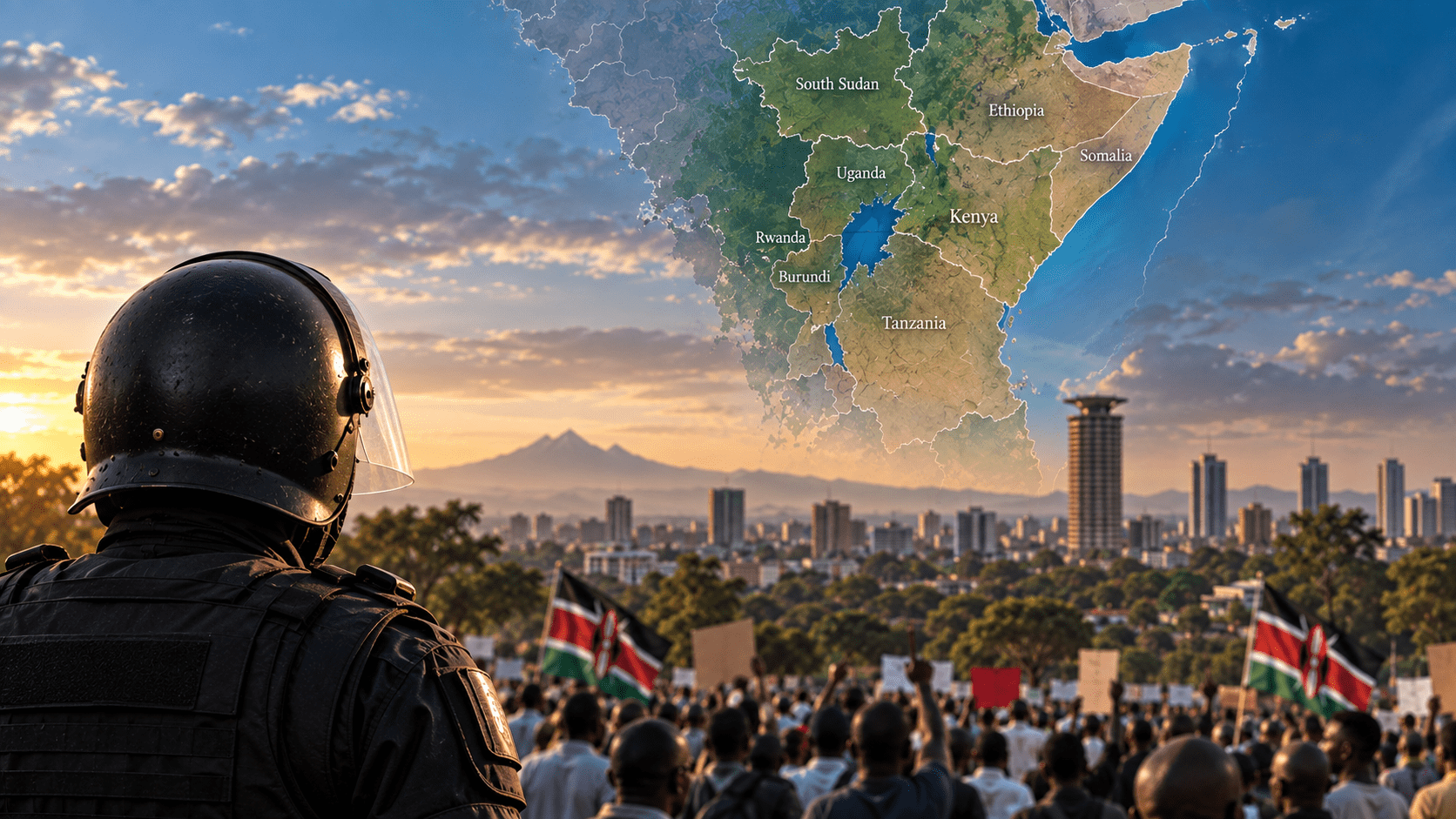
Public-order policing has become a regional security concern because police responses to political gatherings can determine whether contested politics remains contained or leads to wider disruption. Kenya provides a warning: the 2024 demonstrations generated lethal confrontations, extensive property damage and disruption, while the 2025 protest cycle again placed policing, public safety and political legitimacy under intense pressure (Kenya National Commission on Human Rights [KNCHR], 2024; Reuters, 2025a). The underlying issue is wider than Kenya. Across the Greater Eastern Africa, election periods place police between constitutional rights, political competition and public safety (African Commission on Human and Peoples’ Rights [ACHPR], 2017; United Nations Office on Drugs and Crime [UNODC], 2011). Where communities distrust police institutions, enforcement can deepen resistance during demonstrations (Afrobarometer, 2025). Regional institutions remain better organised around electoral mediation and conflict prevention than interoperable public-order policing, even as people, information and commerce move across borders faster than police doctrines do (Intergovernmental Authority on Development [IGAD], 2023). The pressure is institutional as well as political: police commanders must protect public safety and preserve lawful public participation. The purpose of this commentary is to examine how police and other law-enforcement institutions shape the trajectory of political unrest across the Greater Eastern Africa.
2.0 KEY ISSUES
2.1 Election Policing Remains Reactive to Escalation
Election policing remains concentrated on visible disorder rather than preceding risk. In Kenya, demonstrations have shown how political grievances can become public-order emergencies when mobilisation and police deployment converge (KNCHR, 2024; Reuters, 2024a). Similar pressures arise in Greater Eastern Africa when disputed electoral processes, restrictions on assembly and mistrust between authorities and citizens converge around polling periods (ACHPR, 2017; International Crisis Group, 2024). The institutional weakness is temporal: police are often asked to restore order after escalation has already narrowed the space for negotiation. Commanders therefore remain reactive while political and social conditions driving mobilisation remain outside operational planning. The cycle shifts attention toward containment rather than early identification of escalation signals. As election calendars intersect with persistent economic and political pressures, the boundary between electoral preparedness and crisis response becomes increasingly difficult to sustain. That timing gap places greater weight on the quality of decisions made once public mobilisation has already intensified.
2.2 Police Legitimacy Determines Operational Space
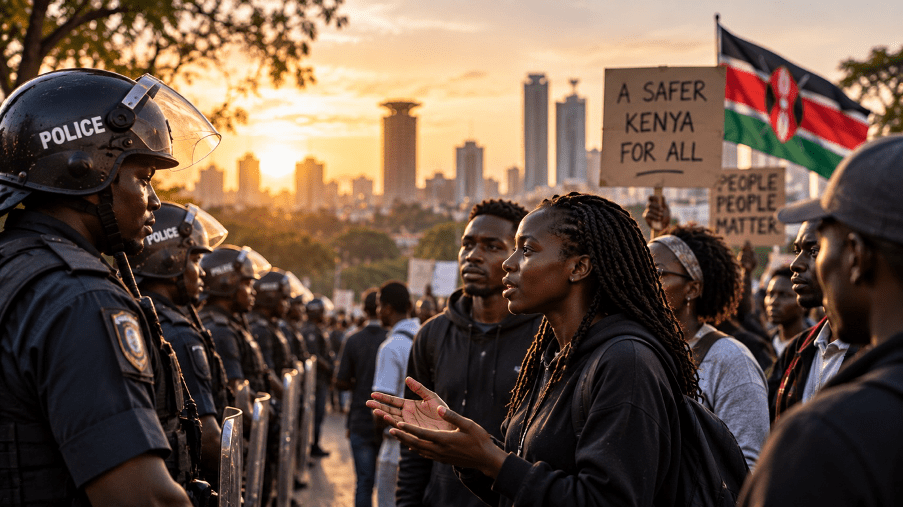
Police legitimacy is an operational asset because public compliance depends partly on whether enforcement is regarded as lawful, impartial and predictable. Where communities distrust police institutions, interventions can acquire political meaning, reducing cooperation at demonstrations (Afrobarometer, 2025; ACHPR, 2017). Kenya’s 2024 protests exposed contested police conduct, with human-rights monitoring documenting fatalities, injuries, arrests, and alleged violations (KNCHR, 2024). Regional experience reinforces the point. Election-related restrictions and confrontations in Uganda and Tanzania have placed policing at the centre of disputes over participation and public order (Amnesty International, 2025; Reuters, 2025b). The problem is cumulative rather than episodic. Each disputed encounter affects expectations about subsequent encounters, narrowing the credibility of police assurances and complicating engagement with organisers, communities and oversight bodies. Legitimacy therefore shapes the operating environment in which public-order decisions are made, not merely institutional reputation. Once that operating environment deteriorates, command decisions face a narrower margin for peaceful de-escalation.
2.3 Regional Security Architecture Lacks Police Interoperability
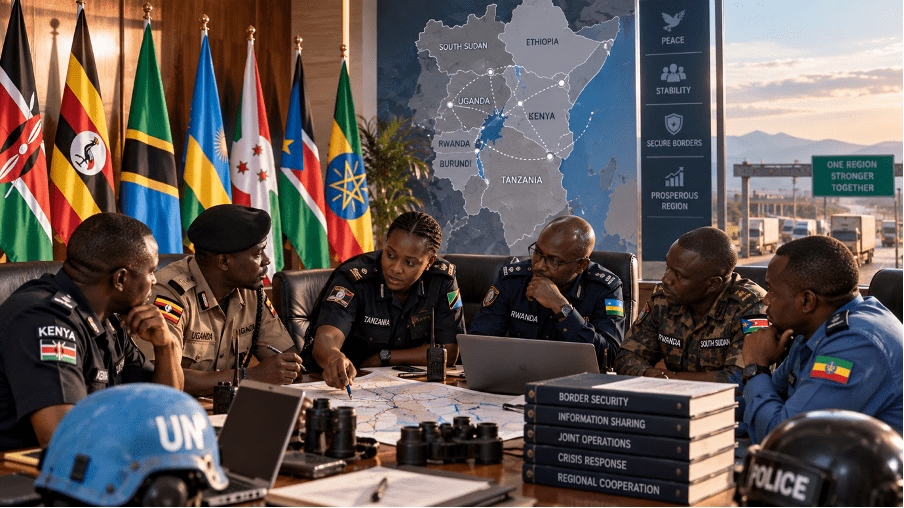
Greater Eastern Africa has mechanisms for conflict prevention, yet public-order policing remains national in doctrine, command, and accountability. IGAD’s early-warning architecture and the East African Community’s peace and security framework address regional risks, but neither creates a common system for managing politically charged public gatherings (IGAD, 2023; EAC, 2024). The gap becomes visible when unrest affects transport corridors, commercial centres, border communities or communications networks (World Bank, 2024; Reuters, 2025c). Police services can confront locally generated disorder whose consequences extend beyond their jurisdiction, while neighbours receive limited structured information. This is an interoperability problem, not simply a training deficit. Differences in legal mandates and oversight constrain lesson-sharing between police services facing similar risks. Regional security architecture consequently operates with stronger mechanisms for political dialogue than for comparative learning from public-order incidents. The resulting disconnect becomes more consequential when a domestic disturbance begins affecting systems that regional institutions already regard as shared security or economic interests.
2.4 Domestic Unrest Produces Regional Security Effects
Domestic policing decisions affect regional economic and security systems because unrest can interrupt movement, trade, communications, and essential services. Kenya’s protest cycles demonstrated how disruption in urban and transport nodes can generate effects beyond the confrontation site (Reuters, 2024b; World Bank, 2024). Comparable vulnerabilities exist across Greater Eastern Africa, where trade and population movement connect urban systems and frontier communities (EAC, 2024; IGAD, 2023). Regional instability does not require unrest to cross borders; disruption of a critical corridor or declining public confidence can transmit risk through markets, information networks, and mobility (International Crisis Group, 2024). Regional institutions tend to treat public-order incidents as domestic events unless they become interstate or humanitarian crises. That threshold is misaligned with the region’s interconnected political economy. Police effectiveness must therefore be understood within a wider system whose first-order disturbance can generate second-order regional effects. The question is consequently no longer confined to how one police service manages one demonstration.
3.0 CONCLUSION
Across Greater Eastern Africa, public-order policing sits at the point where political contestation becomes either contained disruption or leads to wider instability. The four issues reveal a common structural problem: policing remains predominantly national and reactive, while the drivers and consequences of political unrest are increasingly networked across borders. Legitimacy affects operational space; weak regional interoperability limits institutional learning; and disruption in connected urban, commercial and transport systems can transmit national shocks regionally. The challenge is therefore not simply how police respond once disorder erupts. It is whether law-enforcement institutions, electoral bodies and regional mechanisms can connect earlier with credible command, accountable practice and timely information exchange. That connection will shape the region’s capacity to absorb electoral shocks without allowing public-order crises to become broader security disruptions during political unrests.
4.0 POLICY RECOMMENDATIONS
4.1 Establish Permanent Election Public-Order Coordination Cells
National police services, interior ministries and election-management bodies in the Greater Eastern Africa should establish permanent election public-order coordination cells six months before every national election. Each cell should maintain a shared calendar of political events, protest notifications, sensitive locations, emergency-service dependencies and verified incident reports. A written protocol should define information flows, command responsibilities and escalation thresholds, while an independent oversight body should receive serious-incident notifications within fixed reporting periods. IGAD and EAC secretariats should convene quarterly peer reviews using anonymised incident data to identify recurring escalation patterns. The mechanism should operate through existing national mandates rather than create parallel security structures. Its purpose is practical: connect electoral preparedness to public-order planning early enough for commanders to recognise cumulative risk before gatherings become acute operational crises.
4.2 Make Public-Order Command Competence Verifiable
National police services and police academies should offer common public-order command certification lessons for officers assigned to election-period deployments. The curriculum should cover lawful assembly, communication with organisers, graduated intervention, medical coordination, arrest safeguards, incident recording and post-operation review. The certification should be linked to deployment eligibility, with refresher assessment before each national election cycle. Additionally,Independent police oversight institutions should audit selected operations and publish aggregate findings on compliance, complaints and serious incidents. Further AU, IGAD and EAC should develop common training standards and peer-learning forums while leaving operational command under the national law. This approach would turn public-order competence from an assumed attribute into a verifiable institutional requirement. It would also create comparable standards across neighbouring services, allowing commanders to learn from operational experience without requiring uniform national legislation.
4.3 Formalise Electoral and Police Liaison Protocols
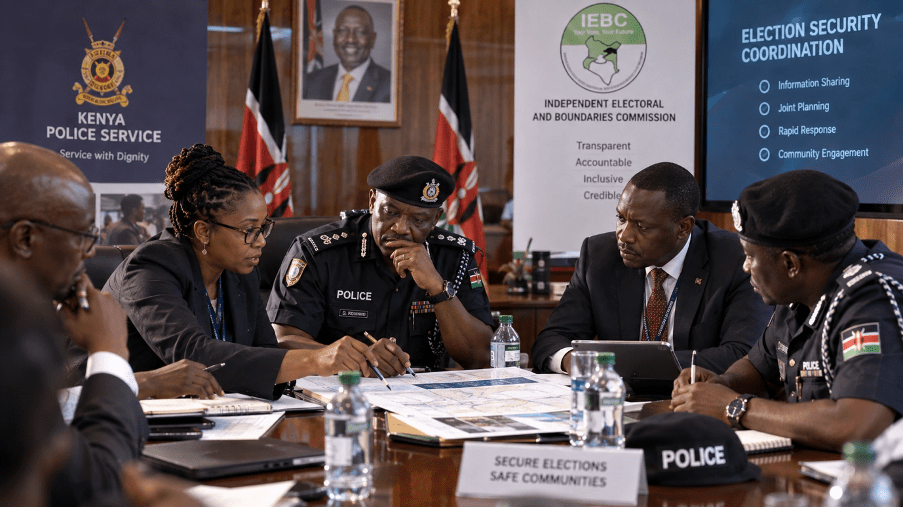
Interior ministries, national police services and electoral commissions should adopt formal public-order liaison protocols before each election period. Each protocol should specify how electoral bodies notify police of scheduled political events, how police communicate operational requirements to organisers, and how disputes concerning assembly restrictions are documented. Police command centres should maintain a shared incident log with electoral and emergency-service counterparts, subject to national data-protection rules. Oversight bodies should review serious incidents using a common reporting template covering orders, operational decisions, injuries, arrests and complaints. IGAD and EAC secretariats should compile anonymised lessons from member states into periodic regional practice notes. The mechanism would clarify institutional boundaries while improving information continuity at moments when electoral legitimacy and public order are simultaneously under pressure. It would also give regional institutions a reliable basis for identifying recurring coordination failures across national systems.
4.4 Create a Regional Public-Order Learning Mechanism
IGAD and EAC secretariats, national police services and interior ministries should establish a regional public-order learning mechanism that converts election incidents into comparable institutional lessons learnt. Participating police services should submit standardised post-election reviews covering escalation patterns, command decisions, civilian complaints, serious incidents and service disruptions. Independent oversight institutions should validate findings concerning major incidents before regional consolidation. The mechanism should maintain an anonymised repository and issue periodic analytical notes identifying recurring operational gaps without ranking national forces or attributing individual blame. The AU should also receive consolidated findings through existing early-warning channels. This arrangement would give regional institutions a structured evidence base for detecting recurring failure patterns earlier. It would also preserve national responsibility for policing while creating a practical regional channel for learning from incidents whose consequences extend beyond one jurisdiction.
5.0 REFERENCES
African Commission on Human and Peoples’ Rights. (2017). Guidelines on freedom of association and assembly in Africa. African Union.
Afrobarometer. (2025). Afrobarometer survey findings on trust in public institutions and policing in Africa. Afrobarometer.
Amnesty International. (2025). The state of the world’s human rights. Amnesty International.
East African Community. (2024). EAC peace and security framework. East African Community Secretariat.
Intergovernmental Authority on Development. (2023). IGAD peace and security architecture. IGAD Secretariat.
International Crisis Group. (2024). Containing political and electoral tensions in Eastern Africa. International Crisis Group.
Kenya National Commission on Human Rights. (2024). Report on the 2024 demonstrations in Kenya. KNCHR.
United Nations Office on Drugs and Crime. (2011). Handbook on police accountability, oversight and integrity. United Nations.
World Bank. (2024). Kenya economic update. World Bank.
Reuters. (2024a). Kenya protests and police response. Reuters.
Reuters. (2024b). Kenya unrest disrupts transport, business and public services. Reuters.
Reuters. (2025a). Kenya protests and police response. Reuters.
Reuters. (2025b). Political tensions and policing in East Africa. Reuters.
Reuters. (2025c). Kenya unrest and regional economic disruption. Reuters.