


1.0 INTRODUCTION
While youth participation is fastly shaping governance across Greater Eastern Africa, demographic size does not automatically confer political influence. The African Youth Charter defines youth as people aged 15 to 35 and recognizes participation rights (African Union, 2006). Survey evidence from 39 African countries shows that people aged 18 to 35 report lower participation than older citizens, particularly in voting, while protest remains a channel of engagement (Afrobarometer, 2025). Kenya’s Gen Z-led mobilization exposed both the digital reach and the risks facing young activists (Malik, 2025; Sharma, 2026). Sudanese youth networks document conflict conditions and advocate for peace amid severe insecurity (United Nations in Sudan, 2025). Kenya, Uganda, Tanzania, and Sudan present different institutional conditions, making national context essential to interpreting youth political participation. These differences shape access, representation, and institutional accountability. Digital communication has accelerated mobilization, yet representation, policy influence, and public oversight depend on processes extending beyond protest (African Union Commission, 2021). Youth is an age-defined category; Gen Z is a generational cohort whose boundaries vary. This commentary examines how youth participation becomes sustained political influence through electoral engagement, civic organization, representation, and accountability.
2.0 KEY ISSUES
2.1 Youth Demographics Do Not Guarantee Electoral Participation or Influence
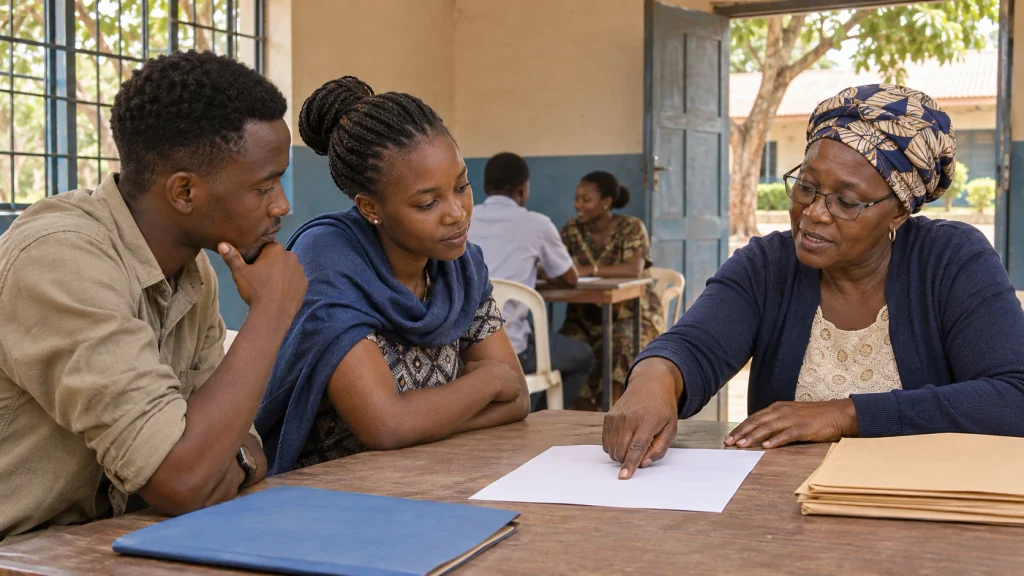
A youth population creates electoral significance, not an automatic voting bloc. Across 39 African countries, citizens aged 18 to 35 were 18 percentage points less likely than older respondents to report voting in their latest election (Afrobarometer, 2025). In Uganda, 52% of people aged 18 to 30 reported voting in 2021, compared with 89% of those older than 30 (Nannozi & Kakumba, 2026). The African Youth Charter recognises participation rights but cannot remove practical barriers, while electoral guidance identifies voter information and meaningful participation in political processes as relevant factors (African Union, 2006; African Union Commission, 2021). The participation gap also extends to party identification and contact with public officials (Afrobarometer, 2025). The unresolved issue is whether young people shape electoral agendas or are mobilised mainly as campaign numbers during national election cycles (Madung, 2025).
2.2 Digital Mobilisation Does Not Guarantee Sustained Civic Engagement or Institutional Influence
Digital platforms lower coordination costs, but online reach does not create civic power by itself. Afrobarometer’s pre-protest survey found an association between online political posting and reported protest participation in Kenya, but it cannot establish what caused the June 2024 demonstrations (Iberi & Yakubu, 2026). Kenya’s Gen Z movement used social platforms to organise outside party structures, but reach did not itself create durable representation or guarantee institutional influence (Dohyee, 2024). Networks can spread false claims and expose participants to surveillance; reporting on Kenya’s digital dissent describes online intimidation and reprisals against young activists (Madung, 2025). Tanzania’s 2025 election protests coincided with nationwide internet disruption, demonstrating how restrictions can interrupt information and coordination (Reuters, 2025b). The gap is between online attention and the organisation’s ability to investigate issues, engage institutions, and track public responses (Mwangi, 2024).

2.3 Youth Mobilisation Does Not Automatically Translate into Formal Political Representation
Participation can shape public debate without giving young people a meaningful role in decisions. Kenya’s 2024 protests were organised through decentralised networks, which enabled rapid coordination but left no single body authorised to negotiate for participants (Malik, 2025). Decentralisation preserves autonomy, yet complicates sustained collective commitments and follow-up. The African Youth Charter recognises participation as a right (African Union, 2006), while continental guidance extends youth engagement beyond campaigns to decision-making (African Union Commission, 2021). Kenya’s protests challenged parliament but left representation unresolved (Reuters, 2025a). Regional governance discussions identify the gap between consultation and meaningful inclusion in decisions (United Nations Development Programme, 2026). Youth and Gen Z are distinct categories, neither politically uniform. The unresolved tension is how participation can enter formal decision-making without requiring movements to surrender autonomy or become instruments of parties and governments.
2.4 Electoral Participation Alone Does Not Ensure Continuous Public Accountability
Voting selects representatives but does not establish whether they fulfil commitments. Accountability requires accessible information, public understanding, and channels to decision-makers. Evidence shows youth participation spans several activities while conventional engagement gaps persist (Afrobarometer, 2025). Sudanese youth networks have organised civic action and peacebuilding during conflict (United Nations in Sudan, 2025). Sudan illustrates civic organisation beyond protest, despite its conflict setting. The African Youth Charter and continental guidance recognise participation rights (African Union, 2006; African Union Commission, 2021). Inaccessible budget, procurement, and legislative information makes oversight episodic. Reporting on Kenya’s youth activism describes continuing demands for accountability and institutional response (Madung, 2025). The persistent gap is weak transmission of civic evidence into official action across the political cycle, including public scrutiny of budgets, procurement and legislative follow-through at all levels (United Nations Development Programme, 2026).
3.0 CONCLUSION
Youth participation across Greater Eastern Africa takes electoral, digital, organisational and accountability forms, but these do not automatically produce sustained influence. Survey evidence shows gaps in conventional engagement, while protest and civic networks create alternative routes into public debate. Yet visibility does not guarantee representation, and representation does not ensure that public commitments are implemented. Kenya, Tanzania and Sudan illustrate distinct political settings and must not be treated as interchangeable cases. Nor should Gen Z be used as a synonym for youth. The central challenge is whether institutions connect young people’s participation to decisions and scrutiny while preserving civic independence. Political legitimacy depends on that connection across the political cycle.
4.0 POLICY RECOMMENDATIONS
4.1 Strengthen Youth Electoral Access, Participation and Influence
National electoral management bodies in Greater Eastern Africa should publish country-specific youth participation plans for national and subnational elections, identifying registration barriers, identification documents, polling access, voter information and complaint procedures. They should deliver voter education through schools, universities, community organisations and online channels, then publish age-disaggregated registration and turnout data where legally permitted and methodologically reliable. Registered political parties should disclose, in their candidate-selection and manifesto processes, how youth members’ proposals were considered and which were adopted or rejected, with reasons. Independent election-observation organisations and youth-led civic groups should assess implementation and publish findings against these indicators, with documented assessment methods. Electoral bodies should respond publicly to substantiated access complaints and explain corrective action through their existing complaint procedures.
4.2 Protect Digital Expression and Strengthening Independent Civic Organisation
National communications regulators, data-protection authorities and courts in each country across the region should apply existing law to review internet restrictions, unlawful surveillance and disclosure of activists’ personal data. Where restrictions occur, the responsible authority should publish the legal basis, geographic scope, duration and review mechanism, subject to narrowly defined security exceptions and judicial oversight. Data-protection authorities should offer an accessible complaint channel and publish aggregate complaint data, decisions and remedies without exposing complainants. Youth-led civic groups and independent media should publish sourced corrections to false claims and use documented digital-safety procedures when coordinating activity. National human-rights institutions should review complaints about digital intimidation through their existing mandates and publish findings. Regulators should publish public reports on restrictions and complaints.
4.3 Expand Institutional Access While Safeguarding Youth Political Independence
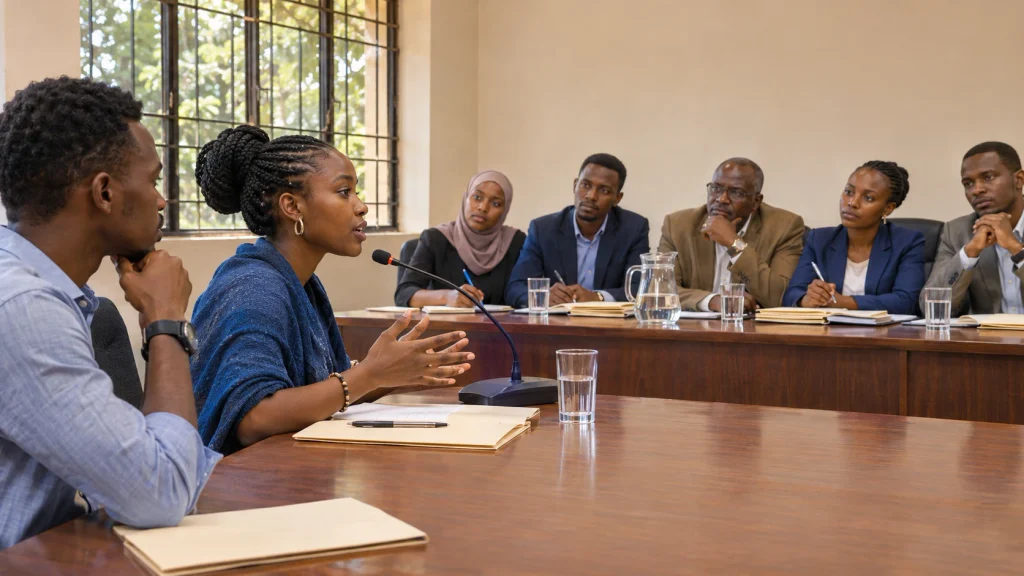
National parliaments, subnational assemblies and ministries across Greater Eastern Africa should publish procedures for youth organisations to submit proposals, give committee evidence and attend public hearings. Notices should state eligibility, selection criteria, submission procedures, responsible committee or office, required written response and appeal channel, including how applicants can challenge selection decisions. Committee clerks and public-participation offices should maintain public registers of submissions, responses and decisions, with personal information redacted. They should record whether a proposal was accepted, amended or rejected and provide reasons. Participation must remain voluntary and independent of party membership or government endorsement. Youth organisations and civil-society monitors should review these records and identify whether submissions changed policy or legislation, rather than counting meetings as proof of influence.
4.4 Use Civic Evidence to Strengthen Public Accountability and Institutional Follow-Through

National treasuries, procurement authorities, supreme audit institutions, public-accounts committees and subnational governments across Greater Eastern Africa should publish budget allocations, procurement awards, expenditure reports and implementation results in accessible, searchable formats. Public-accounts committees should schedule hearings on audit findings, identify the responsible agency, and record corrective action and deadlines. Audit institutions should publish follow-up status for recommendations, distinguishing implemented, pending, disputed and unresolved findings. Youth-led organisations, universities and independent media should compare published commitments with expenditure and delivery records, state their methods and submit evidence through existing audit or parliamentary channels. The responsible committee or agency should publish a response and referral outcome. Public reports should show which findings led to recovery, administrative correction, or investigation, while protecting confidential information.
5.0 REFERENCES
African Union. (2006). African Youth Charter. https://au.int/en/treaties/african-youth-charter
African Union Commission. (2021, December 9). Guide to youth participation in political and electoral processes in Africa. https://www.au.int/en/documents/20211209/manuals-youth-participation-political-and-electoral-processes-africa
Afrobarometer. (2025, August 12). African youth lag behind elders in political and civic participation except for protest, new Afrobarometer flagship report reveals. https://www.afrobarometer.org/articles/african-youth-lag-behind-elders-in-political-and-civic-participation-except-for-protest-new-afrobarometer-flagship-report-reveals/
Dohyee, S. T. (2024, December 12). Journalists and the Gen-Z protest in Kenya. Al Jazeera Media Institute. https://institute.aljazeera.net/en/ajr/article/2967
Iberi, D., & Yakubu, K. (2026, February 16). PP100: Predicting protest participation: Insights from the year before Kenya’s 2024 anti-tax demonstrations. Afrobarometer. https://www.afrobarometer.org/publication/pp100-predicting-protest-participation-insights-from-the-year-before-kenyas-2024-anti-tax-demonstrations/
Madung, O. (2025, May 1). Tortured over a tweet: How the war between Kenya’s Gen Z and their president has moved online. The Guardian. https://www.theguardian.com/global-development/2025/may/01/kenyans-tortured-for-a-tweet-president-ruto-satire-x-youth-gen-z
Malik, N. (2025, January 14). The Long Wave: “How do you teargas a baddie?”Kenya’s Gen Z revolutionaries. The Guardian. https://www.theguardian.com/news/2025/jan/14/how-do-you-teargas-a-baddie-kenya-gen-z-revolutionaries
Mwangi, K. (2024, December 30). 2024: Social media power on politics, governance hit climax. Business Daily. https://www.businessdailyafrica.com/bd/corporate/technology/2024-social-media-power-on-politics-governance-hit-climax-4874170
Nannozi, M., & Kakumba, M. R. (2026, April 9). Indifferent or disempowered? Ugandan youth lag behind older citizens in political and civic engagement (Publication No. AD1165). Afrobarometer. https://www.afrobarometer.org/publication/ad1165-indifferent-or-disempowered-ugandan-youth-lag-behind-older-citizens-in-political-and-civic-engagement/
Reuters. (2025a, January 14). Africa’s youth protests: A storm brewing for 2025? The East African. https://www.theeastafrican.co.ke/tea/news/east-africa/africa-youth-protests-a-storm-brewing-for-2025-4877488
Reuters. (2025b, October 31). More protests in Dar es Salaam after chaotic Tanzanian election. https://www.reuters.com/business/media-telecom/tanzania-tells-civil-servants-students-stay-home-after-chaotic-election-2025-10-30/
Sharma, Y. (2026, June 24). Kenya braces for return of Gen Z protests: How did they begin? Al Jazeera. https://www.aljazeera.com/features/2026/6/24/kenya-braces-for-return-of-gen-z-protests-how-did-they-begin
United Nations Development Programme. (2026, February 18). Intergenerational dialogue explores Gen Z mobilization and governance pathways in Africa. https://www.undp.org/africa/press-releases/intergenerational-dialogue-explores-gen-z-mobilization-and-governance-pathways-africa