

1.0 INTRODUCTION
The significance of the Red Sea crisis for Greater Eastern Africa lies less in the conflict’s location than in the number of regional systems now exposed to the same shock within a single system of interdependent risks. Renewed fighting along Yemen’s Red Sea coast has coincided with attacks on shipping, renewed piracy concerns, and growing movement across the Bab el-Mandeb (Reuters, 2026a), while IGAD continues to treat maritime security and freedom of navigation as regional peace, security, and development concerns (IGAD, 2026a). The regional exposure is concrete. Mombasa links maritime trade to Uganda, Rwanda, the eastern Democratic Republic of Congo, and Burundi (KPA, 2026), while Kenya’s imports from Saudi Arabia increased sharply in 2025 (KNBS, 2026). Meanwhile, displacement from Yemen has reached Djibouti in significant numbers (IOM, 2026). The significance of these developments lies in how the conflict is increasingly affecting the region through maritime security, commercial corridors, and human mobility. This commentary examines these regional changing configurations, identifies the emerging coordination gap across existing regional arrangements, and considers how institutions can respond when one shock produces consequences across several mandates at the same time.
2.0 KEY ISSUES
2.1 The Red Sea conflict is reshaping the regional security environment
The maritime change concern extends beyond the conflict’s proximity to Eastern Africa. It is the convergence of conflict around Yemen’s coast with insecurity in the Red Sea and Gulf of Aden. Houthi forces have advanced along the coast, while attacks affecting Saudi territory and shipping have kept the Bab el-Mandeb within a conflict setting (Reuters, 2026d). IMO’s dialogue brought Djibouti, Ethiopia, Somalia, Sudan and Yemen together around piracy, armed robbery, crime and geopolitical tensions (IMO, 2026b). IMO has reported attacks on shipping and a resurgence of piracy in the Gulf of Aden (IMO, 2026a). Commercial actors are examining alternative routes as channels become less predictable (Associated Press, 2026b). IGAD’s September communiqué places maritime safety and freedom of navigation within peace, security, and development priorities (IGAD, 2026a). The emerging issue is interaction between conflict geography, maritime risk, and security exposure.
2.2 Red Sea disruption is exposing regional corridor dependence

The economic issue is not that Red Sea disruption affects trade, which is established. It is how disruption exposes dependence on maritime-inland corridors serving markets beyond the coast. Mombasa connects Uganda, Rwanda, eastern Democratic Republic of Congo and Burundi, making port conditions relevant to inland supply chains (KPA, 2026). Attacks on Saudi shipping and infrastructure have added pressure to Red Sea energy routes (Associated Press, 2026a). Kenya’s 2026 Economic Survey records a 90.3 per cent rise in imports from Saudi Arabia in 2025, including gas oil and premium gasoline (KNBS, 2026). Reuters reports that rerouting increases voyage time, freight, fuel, and insurance costs (Reuters, 2026b). Eastern African importers are reporting concern over costs linked to Bab el-Mandeb disruption (The East African, 2026). The emerging gap is visibility of how maritime shocks propagate through interconnected corridors.
2.3 Yemen’s displacement is creating a cross-Red Sea mobility corridor
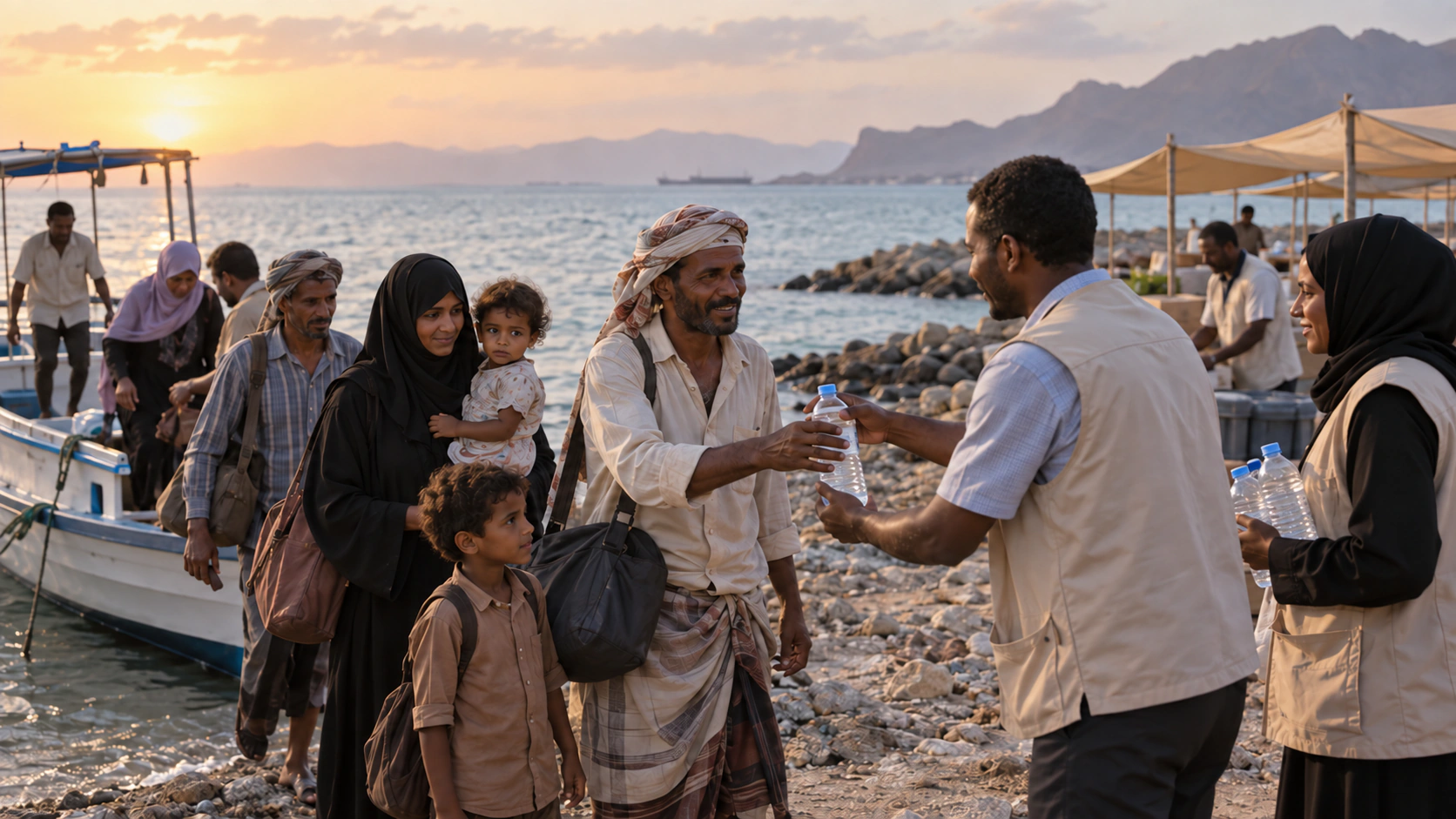
The humanitarian change is not simply displacement from Yemen. It is the emergence of a cross-Red Sea mobility corridor linking Yemen’s conflict with reception and protection systems in the Horn. IOM recorded 118,086 people displaced in Yemen between the June escalation and 17 September 2026 (IOM, 2026). UNHCR reported displaced people and arrivals in Djibouti as people crossed the Bab el-Mandeb (UNHCR, 2026). Associated Press reported fuel shortages as Djibouti prepared for arrivals (Associated Press, 2026c). Reuters reported 112,000 people displaced in Yemen and thousands reaching Djibouti (Reuters, 2026c). Al Jazeera reported more than 3,400 arrivals along Djibouti’s coast within 48 hours (Al Jazeera, 2026). Existing actors are responding, but the route itself changes the operating picture: movement, reception, protection and onward mobility now directly connect the two sides of the Red Sea.
2.4 One regional shock is crossing multiple institutional mandates
The institutional issue is not an absence of mechanisms. Maritime security, trade, migration and displacement already sit within national, regional and international arrangements. IGAD places maritime governance within peace, security and development priorities (IGAD, 2026a). IMO’s dialogue connects maritime agencies across Djibouti, Ethiopia, Somalia, Sudan and Yemen around piracy, organised crime and geopolitical tensions (IMO, 2026b). Commercial actors are adjusting routes as security conditions change (Reuters, 2026b). IOM’s displacement tracking records movement from Yemen, linking humanitarian information to the cross-Red Sea corridor (IOM, 2026). Associated Press reports Somali businesses are examining alternative maritime routes as established channels become less predictable (Associated Press, 2026b). The emerging regional gap is interoperability: whether information generated within separate regional mandates can be connected quickly enough when one external shock produces simultaneous maritime, commercial, humanitarian and security consequences across jurisdictions.
3.0 CONCLUSION
Red Sea insecurity is exposing a configuration in which one conflict is generating effects across maritime security, corridors and human mobility. The significance is not that the region remains exposed to Red Sea instability; it is that the same shock now travels through systems that are developed but organised around mandates, information flows and decision cycles. Maritime authorities can track vessel risks, trade institutions can observe corridor pressures, and humanitarian actors can record displacement, yet the consequences can unfold faster than these systems connect. The regional challenge is therefore interoperability rather than institutional absence: linking information and decisions when a single development produces several forms of pressure simultaneously across borders.
4.0 POLICY RECOMMENDATIONS
4.1 Establish a common maritime incident reporting protocol
IMO, working with IGAD and national maritime authorities, should establish a common maritime incident reporting protocol using existing arrangements. The protocol should define minimum categories for attacks, piracy, armed robbery, suspicious vessel movements, route closures and verified navigational warnings, with national focal points responsible for submission and validation. IMO should maintain the technical reporting standard, while IGAD should circulate authenticated regional alerts through existing coordination channels. National authorities would retain operational command and response decisions. Quarterly reviews should assess reporting delays, unresolved incidents, and coverage gaps, with corrective actions assigned to responsible institutions. The protocol should also specify escalation thresholds and procedures for sharing validated information with relevant trade and humanitarian authorities when an incident has consequences beyond maritime operations.
4.2 Establish regional monitoring of corridor exposure
The EAC Secretariat, working with IGAD and corridor institutions, should establish regional monitoring of Red Sea exposure within trade-monitoring arrangements. The mechanism should track freight and insurance costs, vessel diversions and delays, fuel-import exposure, and disruption along inland corridors. National customs, port, energy and transport authorities should submit agreed indicators monthly through designated focal points. The EAC Secretariat should issue a regional exposure note when predefined thresholds are crossed, while IGAD should contribute information from affected member states. The monitoring should distinguish temporary shipping delays from sustained supply disruption and identify exposed corridors and commodities. This would make corridor information more useful for timely, coordinated regional government contingency planning decisions without creating a parallel trade institution or prescribing procurement decisions.
4.3 Extend established displacement reporting to the Red Sea route
IOM and UNHCR, working through IGAD’s migration and displacement coordination arrangements with Djibouti and affected states, should extend established displacement reporting to the Red Sea route. The mechanism should use a reporting template covering arrivals, onward movement, protection needs, reception capacity and service pressure, with national focal points responsible for verification. IOM and UNHCR should consolidate validated information with IGAD’s regional displacement data and issue situation updates when agreed thresholds are reached. Djibouti should retain responsibility for national reception decisions, while participating states should activate existing humanitarian and protection procedures. Scenario exercises should test reporting, referral and reception workflows. This would extend established data coverage to an emerging mobility route without creating a parallel displacement architecture or altering institutional mandates.
4.4 Conduct critical reviews for compound shocks

The AU Peace and Security Council Secretariat, IGAD, the EAC and IMO should conduct critical reviews and checks for compound shocks using existing mandates. Each exercise should model a sequence such as a maritime attack followed by route disruption, fuel delays, and population movement. Institutions should map alert receipt, validation, information escalation, decision points, and mechanisms activated at each stage. IGAD should coordinate Horn-related dimensions, the EAC should examine corridor and trade effects, and IMO should assess maritime implications, while the AU should review security consequences. Each exercise should end with an action matrix assigning coordination gaps to institutions, deadlines, and review points. The objective is to test whether systems can connect decisions across mandates before a compound shock becomes several crises.
5.0 REFERENCES
Al Jazeera. (2026, September 15). Thousands flee to Djibouti amid renewed Yemen fighting. https://www.aljazeera.com/news/2026/9/15/thousands-flee-to-djibouti-amid-renewed-yemen-fighting
Associated Press. (2026a, September 15). Saudi crown prince seeks Egypt’s backing as Houthi attacks rattle Red Sea oil routes. https://apnews.com/article/5696629010c86b8cc83f69cbd093e3f1
Associated Press. (2026b, September 13). Somalis rethink trade routes as Houthis disrupt established shipping channels. https://apnews.com/article/af8faa88a444ec429a3d1b5df7b89da1
Associated Press. (2026c, September 15). Yemen fuel shortage hampers migrants trying to flee conflict for the safety of Djibouti. https://apnews.com/article/0382bf63a25d98e87477bf7f13b9577a
Intergovernmental Authority on Development. (2026, September 16). Communiqué of the 74th Extraordinary Session of the IGAD Council of Ministers. https://igad.int/communique-of-the-74th-extraordinary-session-of-the-igad-council-of-ministers/
International Maritime Organization. (2026a, August 24). IMO calls for urgent action as piracy resumes in the Gulf of Aden. https://www.imo.org/en/mediacentre/pressbriefings/pages/imo-calls-for-action-on-piracy-following-recent-attacks.aspx
International Maritime Organization. (2026b, September 3). Regional cooperation key to maritime security in the Red Sea and Gulf of Aden. https://www.imo.org/en/mediacentre/pages/whatsnew-2490.aspx
International Organization for Migration. (2026, September 17). Internal displacement: Yemen. https://dtm.iom.int/domain/displacementiomint?page=0
Kenya National Bureau of Statistics. (2026). Economic survey 2026. https://www.knbs.or.ke/wp-content/uploads/2026/04/2026-Economic-Survey.pdf
Kenya Ports Authority. (2026). Performance contract 2025/2026. https://portal.kpa.co.ke/web-uploads/documents/768c92ba-2ec1-4c2b-9aba-25839e9d5ba6.pdf
Reuters. (2026a, September 13). Houthis attack Saudi Arabia as Gulf-Iran talks are postponed. https://www.reuters.com/business/energy/diplomacy-stumbles-with-postponement-meeting-strait-hormuz-proposal-2026-09-13/
Reuters. (2026b, September 14). Morning Bid: Shipping oil gets ever harder, costlier. https://www.reuters.com/markets/europe/global-markets-view-europe-2026-09-14/
Reuters. (2026c, September 18). Yemen conflict displaces 112,000 people inside country, thousands flee to Djibouti, UN migration agency says. https://www.reuters.com/world/middle-east/yemen-conflict-displaces-112000-people-inside-country-thousands-flee-djibouti-un-2026-09-18/
Reuters. (2026, September 16). Yemen offensive elevates enigmatic Houthi commander’s standing. https://www.reuters.com/world/middle-east/houthi-red-sea-offensive-elevates-enigmatic-yemeni-commanders-standing-2026-09-16/
The East African. (2026, July 25). Houthi shipping threats rattle East African trade. https://www.theeastafrican.co.ke/tea/business-tech/houthi-shipping-threats-rattle-east-african-trade-5536868
United Nations High Commissioner for Refugees. (2026, September 15). Yemen: Escalating conflict drives new displacement and refugee arrivals in Djibouti. https://www.unhcr.ca/news/yemen-escalating-conflict-drives-new-displacement-and-refugee-arrivals-in-djibouti/