

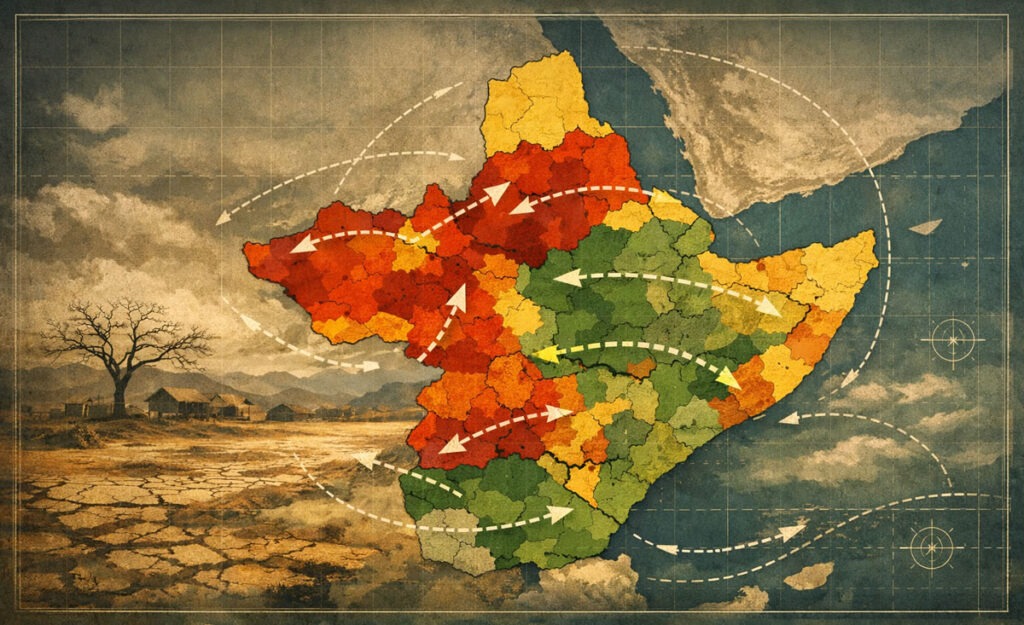
Conflict across Greater Eastern Africa rarely unfolds in isolated incidents. It is often shaped by a mix of political undercurrents, economic pressures, social grievances, and regional spillovers that reinforce one another over time. For governments, embassies, multilateral agencies, civil society, and the private sector, the challenge is not just monitoring events, but interpreting patterns and anticipating how risks may evolve.
This is no mean task, and this is where specialist security foresight organisations such as Mashariki Research and Policy Centre (MRPC) play an important role. They identify, analyze, and interpret emerging risks before they escalate into crises, leveraging structured foresight that is grounded in data but oriented toward decision-making.
A Region Defined by Interconnected Risks
Greater Eastern Africa – stretching across the Horn, the Great Lakes, and parts of the wider Eastern Africa corridor – is a strategically significant yet highly interconnected region where conflicts are rarely contained within national borders.
Political instability in one country can trigger refugee flows, disrupt trade routes, or generate insecurity affecting neighbouring states. Cross-border pastoralist tensions, transnational criminal networks and porous borders further complicate the landscape and make it harder to contain conflict dynamics.
This interconnection means that conflict trends must be analysed regionally, not just nationally.
Across the region, conflict risks also tend to emerge from the interaction of multiple pressures rather than a single trigger. These factors typically fall across several interrelated domains: political and governance dynamics, economic constraints, localised and resource-based tensions, information ecosystems, and regional geopolitical influences. Examining these drivers systematically helps identify where risks may intensify and where preventive engagement may be most effective.
Political and Governance Dynamics
Political and governance dynamics remain central to conflict trajectories across Greater Eastern Africa, with electoral cycles, constitutional reforms, and shifts in executive authority often acting as critical stress points that intensify political competition and test institutional resilience, especially in contexts where governance deficits, perceived exclusion, or low public trust persist.
Governance deficits may manifest through contested electoral processes, concerns about transparency in electoral management bodies, or perceived weakening of institutional checks and balances. In several countries in the region, debates around constitutional amendments, term limits, and concentration of executive power have at times contributed to perceptions of political exclusion among opposition groups, the youth, and marginalised communities. These dynamics are often compounded by low public trust in state institutions, particularly where citizens perceive limited responsiveness to socio-economic grievances or uneven access to political participation. In such circumstances, political competition can extend beyond formal processes into protest mobilisation, digital activism, or heightened political polarisation, amplifying underlying structural vulnerabilities and increasing the risk of instability.
Economic-Security Nexus
Economic vulnerabilities are increasingly acting as catalysts that transform underlying grievances into collective mobilisation across the region. Rising living costs, unemployment-particularly among youth,and perceptions of inequality are reshaping how instability manifests.
The 2024 youth-led protests in Kenya offer a clear illustration. What began as opposition to proposed fiscal measures quickly evolved into a broader expression of frustration with economic governance, political accountability, and opportunity gaps coming to the fore.
Notably, the protests were decentralised and digitally mobilised, spreading rapidly across urban centres, and driven largely by a younger demographic less tied to traditional political structures. They were also narrative-led, with online discourse shaping both mobilisation and public perception.
While largely framed as economic protests, their implications extended into the political and security space, prompting state response, influencing investor sentiment, and highlighting vulnerabilities in urban stability.
Although rooted in national conditions, similar scenarios have been recorded across multiple countries in the region, suggesting a broader trend in which economic stress functions as a trigger rather than merely a background condition.
Information Ecosystems
Information ecosystems are also becoming increasingly central to how grievances are interpreted, amplified, and acted upon. Digital platforms accelerate the circulation of narratives, misinformation, and mobilisation signals, often shaping public sentiment faster than developments on the ground.
In sensitive contexts, shifts in perception can act as early indicators of escalation risk. Integrating perception analysis alongside incident monitoring therefore provides a more complete understanding of evolving tension.
Localised and Resource-based Tensions
Another persistent pattern across Greater Eastern Africa is the prevalence of sub-national conflicts with national-level implications.
Communal violence, resource-based disputes, and localized insurgencies often erupt in marginalised areas where state presence is limited. While geographically contained, their cumulative effect can strain state capacity, weaken investor confidence, and, in some cases, feed into national political tensions.
Understanding how local dynamics scale into broader instability is therefore essential to anticipating escalation pathways.
Regional Geopolitical Influences
Regional geopolitical dynamics also interact with domestic pressures in ways that shape conflict environments across Greater Eastern Africa, often in subtle but consequential ways. Competition over strategic ports and maritime access in the Horn of Africa, particularly Ethiopia’s evolving engagement with Djibouti and alternative port arrangements, illustrates how access to trade corridors can influence political alignments, economic diplomacy, and internal stability considerations.
In the Great Lakes region, external security partnerships and resource interests have intersected with local conflict dynamics, most notably in the eastern Democratic Republic of the Congo, where the presence of armed groups, cross-border security concerns, and competition linked to strategic minerals have complicated stabilisation efforts and peace processes.
While rarely primary drivers of conflict, these factors can intensify existing vulnerabilities or complicate conflict resolution processes. For diplomatic and multilateral actors, understanding how external interests interact with domestic pressures is essential to navigating policy engagement and programme design.
From Monitoring to Strategic Foresight: The MRPC Approach
MRPC analyses conflict trends through continuous monitoring of intra and inter-state dynamics, communal tensions, and hybrid armed actors across Greater Eastern Africa. The Centre tracks political, social, and resource-driven pressures, with particular attention to borderlands, fragile localities, and areas where sub-national tensions risk wider spillover. Field-informed assessments complement data analysis to ensure grounded interpretation of emerging risks.
Structured methodologies translate these signals into forward-looking insights, while tools such as the Conflict Vulnerability Index (CVI), geospatial risk mapping and scenario modelling help identify hotspots, escalation pathways, and short- to medium-term risk trajectories.
These insights inform the CVI-Kenya dashboard, Mashariki Monthly Outlook, policy briefs, policy commentaries, forecast reports, and rapid analytical notes designed to support timely decision-making.
By linking real-time monitoring with predictive analysis, MRPC supports early warning, preventive engagement, and more targeted responses among decision-makers in complex and evolving conflict environments.